A reflection on generational pain, unseen love, and what it means to hold both
Sometimes the hurt we carry doesn’t start with us.
It starts with a parent who was too harsh or too absent.
Too anxious. Too distracted.
Too consumed by their own pain to fully see us.
They passed down what they didn’t know how to heal—not because they didn’t love us, but because love, on its own, isn’t always enough to keep pain from spilling over.
So we grow up with invisible bruises.
Holes where comfort should’ve been.
And we vow: I will never do that to my children.
And we don’t.
Not exactly.
But we do other things.
We overcompensate. Or we freeze.
We hold too tightly or not tightly enough.
We try so hard to do it differently that we sometimes forget to do it authentically.
And then one day, something shifts.
Maybe it’s the way your child pulls away from you.
Or how they say, “You don’t listen,” and it echoes something you said to your own parent when you were young.
Maybe it’s the ache of realizing you hurt them—not in the same way you were hurt, but not in the same way either.
There’s a sacred pain in that moment. The kind that cracks you open just enough to see what’s really there.
You start to realize:
You didn’t hurt your child because you didn’t love them.
You hurt them in the places where you were still hurting.
And if that’s true for you… then maybe it was true for your parent, too.
Maybe the way they failed you wasn’t a reflection of your worth.
Maybe it was a reflection of their wounds.
Maybe they loved you deeply—but their pain was louder than their love could be.
That doesn’t erase the impact.
It doesn’t mean it didn’t matter.
But it softens the story.
It lets you stop carrying the guilt of what you’ve passed down and the shame of what you never received.
And it opens the door to something else:
Compassion. Repair. And the possibility to give what you didn’t get.
So ask yourself:
• What did I need from my parent that I didn’t get?
Not just what they did wrong—but what I longed for underneath that.
Was it safety? Softness? Encouragement? Consistency? Space to be who I was?
• What have I done in response to that pain?
Overcorrected? Avoided? Repeated it in new forms?
• And what might it look like now to offer my child what I once needed?
Not perfectly. But intentionally.
With more presence, more humility, more humanity.
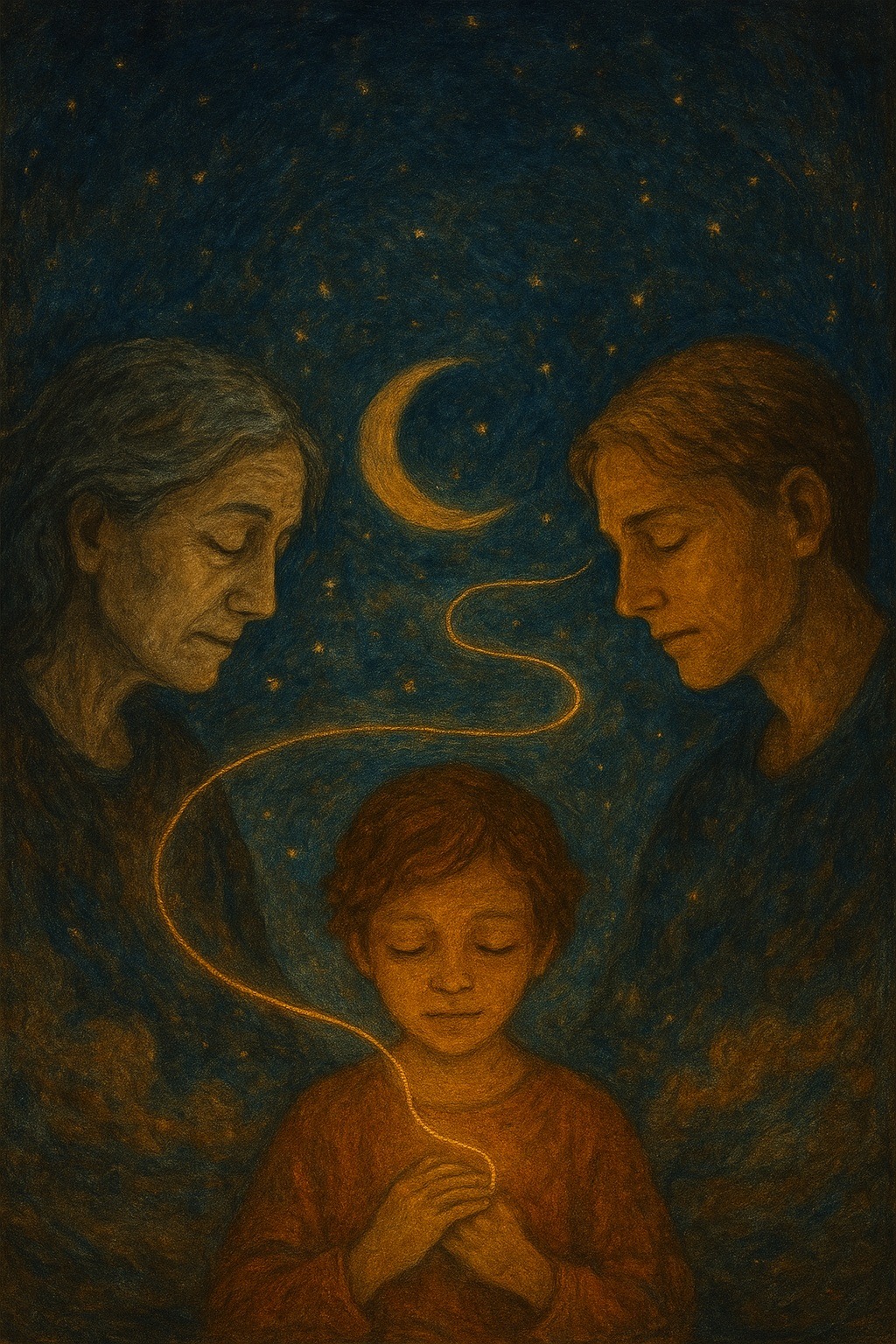
This is what it means to be the bridge.
To see the pain that came before you and the pain that has come through you—and to hold both with tenderness, without letting either define what comes next.
Because even if the cycle has already continued in some way, you can still pause.
Still turn toward your child and say, “I see you. I’m learning. I want to love you better.”
And in that same breath, you might finally say to the younger part of you, “I see you too. You didn’t deserve that. And it wasn’t your fault.”
You don’t have to get it all right.
But you do have to be willing to look.
To feel.
To choose something more honest than perfection: connection.
And maybe—on the best days—you’ll feel a flicker of something new.
Not just the pain of what wasn’t.
But the beauty of what can still be.
You, as the one who sees.
Who stretches between generations, not to fix or erase, but to hold love and pain in the same hand—finally, fully.
And that is no small thing.
Embracing Shadows, Illuminating Hope,
Chelsey Fjeldheim, LCSW
Empowering Souls on the Path of Healing
Copyright © 2025 Chelsey Fjeldheim, Courage Speaks Counseling