(aka: empathy has boundaries too)
There’s a quiet kind of pain that comes from understanding why someone hurt you.
You don’t excuse it.
But you understand it.
You see their childhood.
You see the wound behind the words.
You see the scared part that gets loud when it’s cornered.
And in a way, it’s a gift—to see it that clearly.
But what no one talks about is how heavy it can be.
Because when you understand someone’s trauma, it gets confusing when they hurt you.
Even if you know they didn’t mean to.
Even if you know where it comes from.
Understanding it doesn’t mean it’s okay.
That’s the part many of us—especially the tender-hearted, trauma-informed, emotionally fluent crowd—have to wrestle with.
We’re so good at seeing someone’s pain that we forget we’re allowed to have limits.
Sometimes the most loving, honest, grounded thing you can say is:
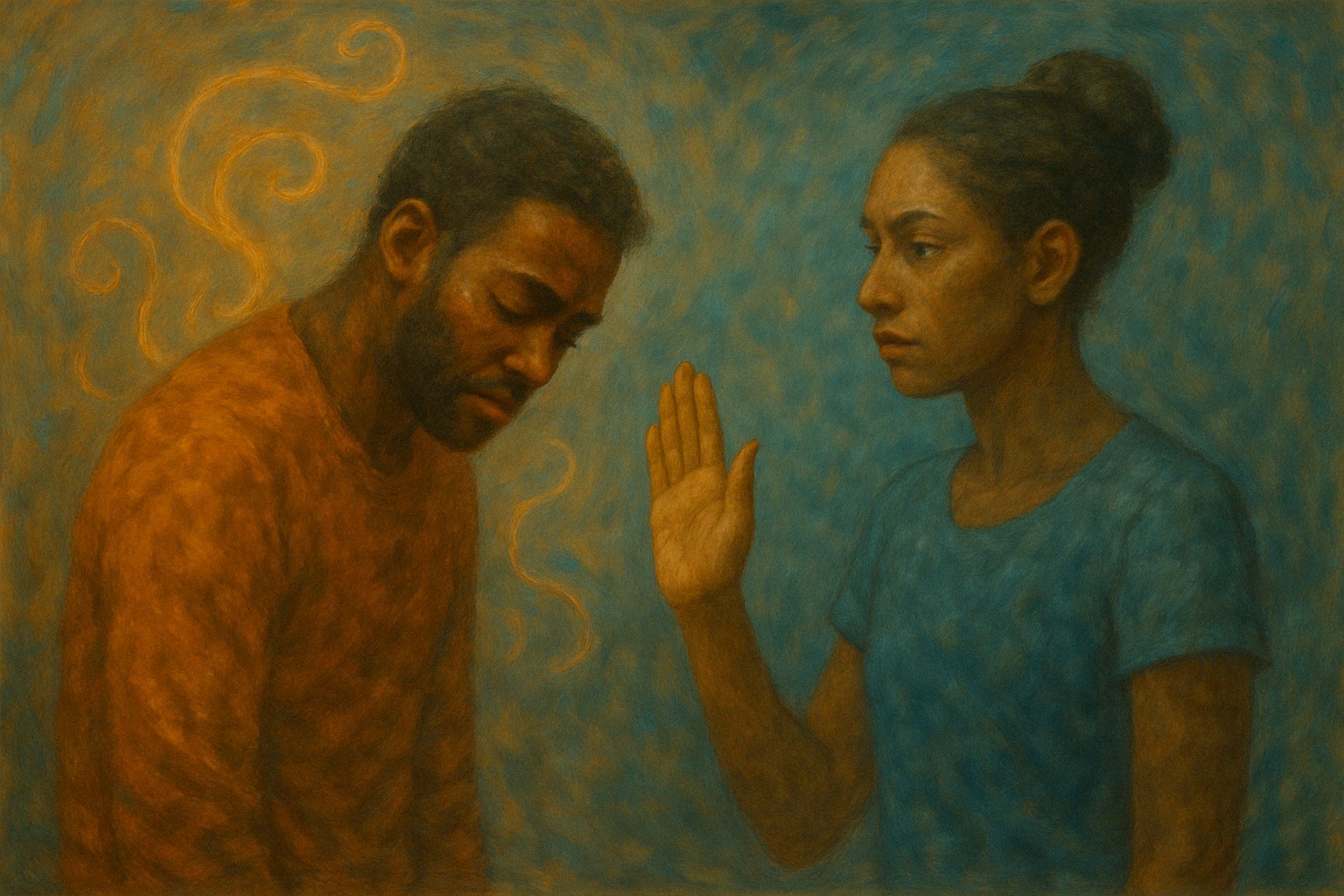
“I see where that comes from… and also, no.”
No, you don’t get to talk to me like that.
No, I won’t be the container for your unchecked rage.
No, I’m not your emotional punching bag just because I get your backstory.
It’s not unkind to name what’s not okay.
In fact, it’s often the only way things ever change.
Because sometimes, what we think is compassion is actually a quiet form of self-abandonment.
We call it empathy, but really, we’re swallowing our own feelings to make room for someone else’s.
We’re tolerating behavior that hurts us because we don’t want to retraumatize them.
We’re walking on eggshells around someone we get—but who doesn’t seem to get us back.
That’s not empathy. That’s a one-way street paved with very good intentions and very poor boundaries.
It’s okay to be trauma-informed and still hold the line.
It’s okay to understand why someone is the way they are and still choose to step back.
It’s okay to love someone and also need space from them.
You are not less kind for naming what hurts.
You are not less wise for wanting mutual respect.
You are not less evolved for saying, “I get it—and I still won’t allow it.”
Empathy isn’t meant to erase your boundaries.
It’s meant to deepen your understanding so you can choose your boundaries with clarity.
And if you’ve ever struggled to hold that line, you’re not alone.
It’s a subtle rebellion to say:
I see your pain. I honor it.
And I will not let it run the show.
Embracing Shadows, Illuminating Hope,
Chelsey Fjeldheim, LCSW
Empowering Souls on the Path of Healing
Copyright © 2025 Chelsey Fjeldheim, Courage Speaks Counseling