
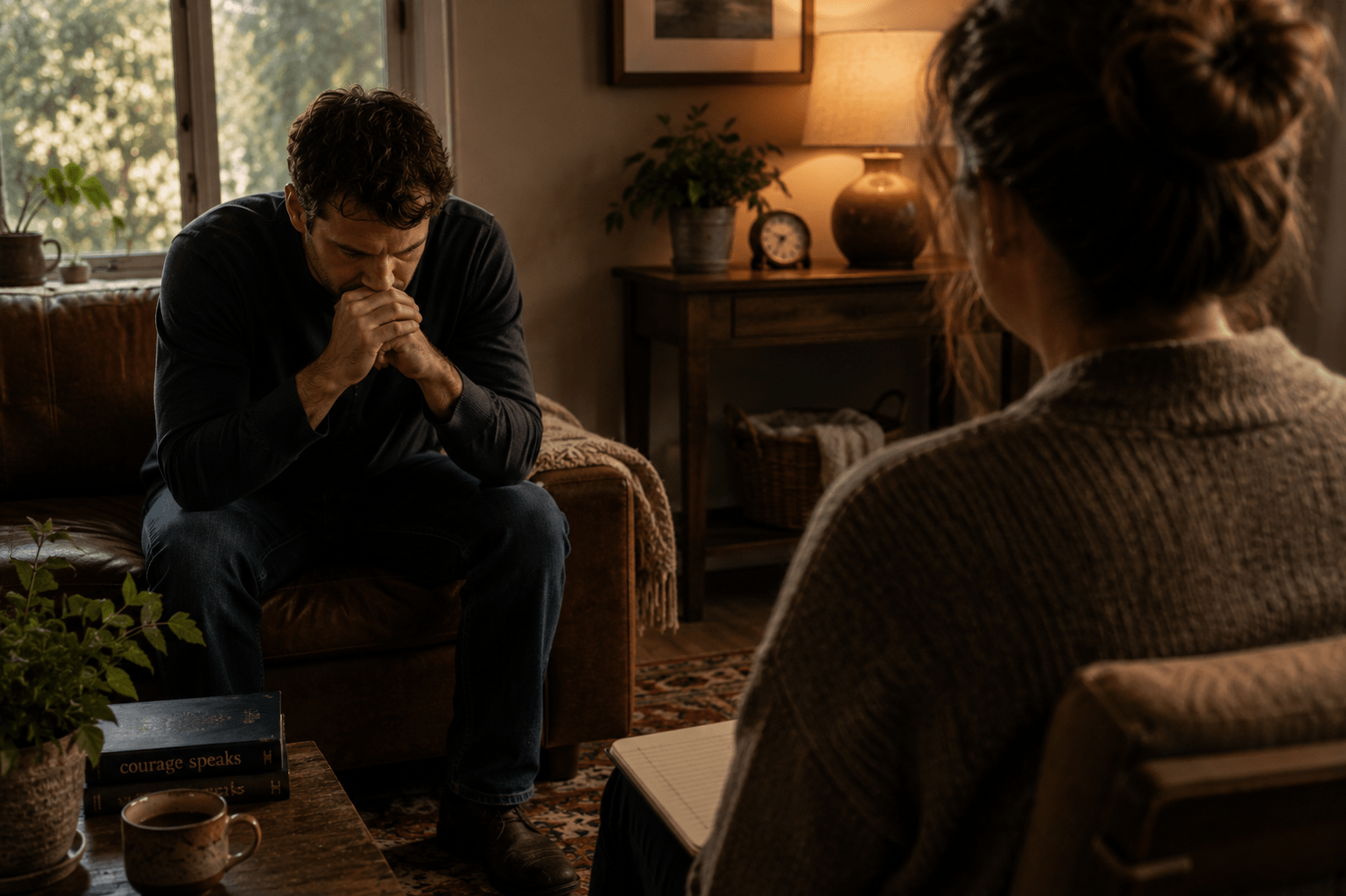
There are moments in therapy when someone says something they’ve never said out loud before.
Sometimes they whisper it.
Sometimes they laugh while they’re saying it, as if that somehow makes it less true.
Sometimes they stare at the floor because they can’t bear to watch another person’s face while the words leave their mouth.
And every once in a while, they look up, almost bracing for what comes next.
They’re waiting for the look.
The one they’ve seen before.
Disappointment.
Disgust.
Pity.
Distance.
Instead, something else happens.
Not because the story isn’t heartbreaking.
Sometimes people have been deeply wounded.
Sometimes they’ve deeply wounded someone else.
Sometimes they’re carrying both.
Sometimes the hardest thing they bring into the room isn’t fear.
It’s the quiet belief that if another person truly knew everything, they would understand why they’re no longer worth loving.
That changes the room.
Not because the past disappears.
Not because accountability no longer matters.
Not because consequences suddenly become easier to carry.
But because beneath everything they’re carrying, there is still a human being.
One who has loved.
One who has been afraid.
One who has tried to survive.
One who has made choices they would give anything to undo.
One whose life cannot be reduced to the worst thing they’ve ever done.
Or the worst thing that has ever been done to them.
People sometimes imagine therapists spend their days analyzing, diagnosing, or figuring people out.
Most of the time, it feels much simpler than that.
It feels like meeting someone beneath the story they’ve spent years believing about themselves.
The story that says they’re too much.
Or not enough.
Too broken.
Too damaged.
Too guilty.
Too ashamed.
Too far gone.
And once you’ve met the person beneath that story, it’s surprisingly difficult not to love them.
Not because they’re innocent.
Not because they’ve earned it.
Not because they’ve finally figured everything out.
But because you’ve seen enough of their story to understand how they got there.
Not to excuse it.
To understand it.
After enough years of this work, something begins to change.
You stop being captivated by people’s strengths.
You stop being impressed by polished versions of them.
You find yourself drawn to the places they’ve spent a lifetime trying to hide.
The terrified child who still apologizes for existing.
The exhausted parent convinced they’re failing everyone.
The teenager who learned anger felt safer than grief.
The spouse carrying unbearable regret.
The person who cannot imagine forgiving themselves.
Not because those places are beautiful.
Because they’re human.
Maybe that’s what people are sensing when they say they finally felt seen.
Not that someone agreed with everything they’d done.
Not that someone excused what happened.
Not even that someone had answers.
Just that, for a little while, another human being looked directly at the place they were most certain made them unlovable…
…and loved them anyway.
Not because that chapter didn’t matter.
Because it did.
Not because the choices didn’t have consequences.
Because they did.
But because no chapter, no matter how heartbreaking, no matter how shameful, no matter how much regret it carries, has ever been big enough to tell the whole truth about another human being.
Maybe we aren’t changed by finally becoming lovable.
Maybe we’re changed by discovering we were loved in the place we were most certain no one could.
Embracing Shadows, Illuminating Hope,
Chelsey Fjeldheim, LCSW
Empowering Souls on the Path of Healing
Copyright © 2026 Chelsey Fjeldheim, Courage Speaks Counseling